VeloxChem has the stated goal to be science-enabling and should provide:
a fast return of results
coverage of dense 3D system of sizes up to and beyond 500 atoms in the quantum region
accurate description of electronically excited states that show a more diffuse character than the ground state
stable and reliable convergence of iterative equation solvers
automatized workflows for complex simulations involving e.g. embedding and dynamics
Performance and scaling
Personal computers (laptop/desktop)
Resolution of identity
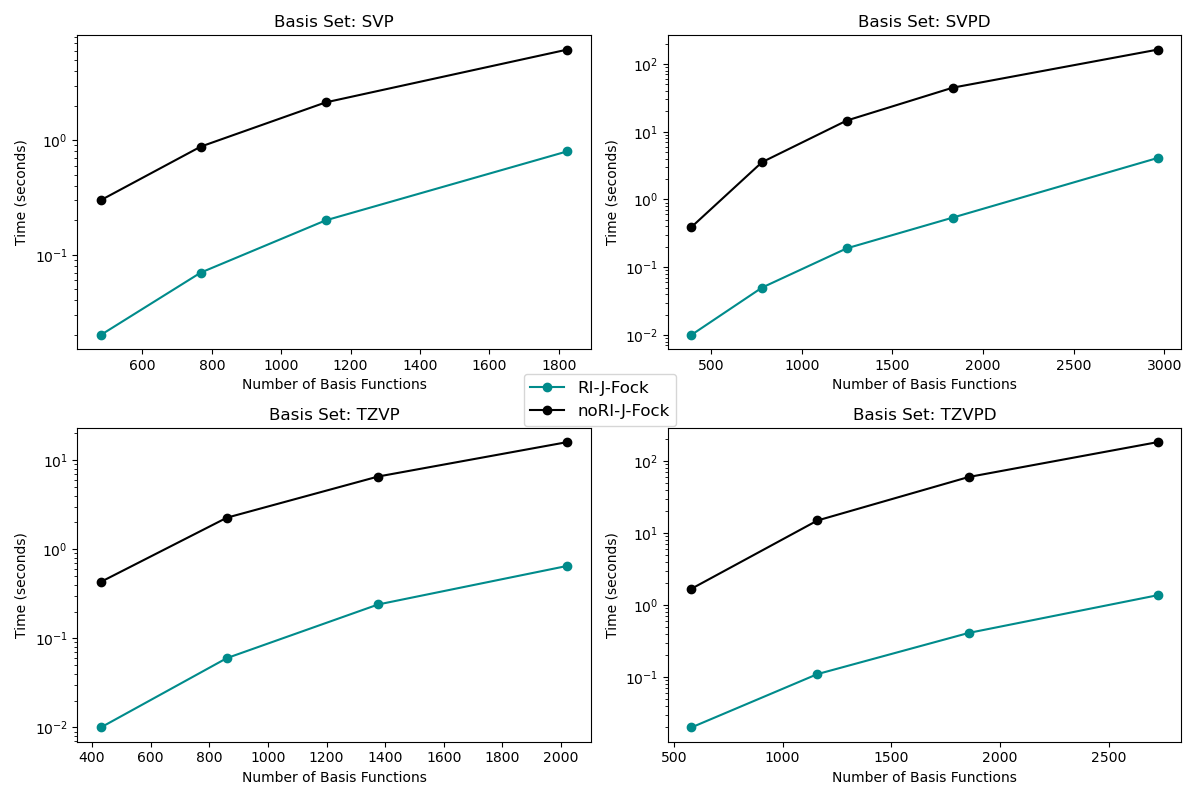
Timings are in seconds, measured on 1 LUMI-CPU node with 128 cores (8 MPI x 16 OMP). Systems are water clusters of different sizes. The time spent in one Fock-J build is measured with and without RI. Speedup can be 10x, 20x, 40x or 100x depending on basis set and system size
High-performance computing
HPC-CPU
MPI/OpenMP parallel Fock matrix construction
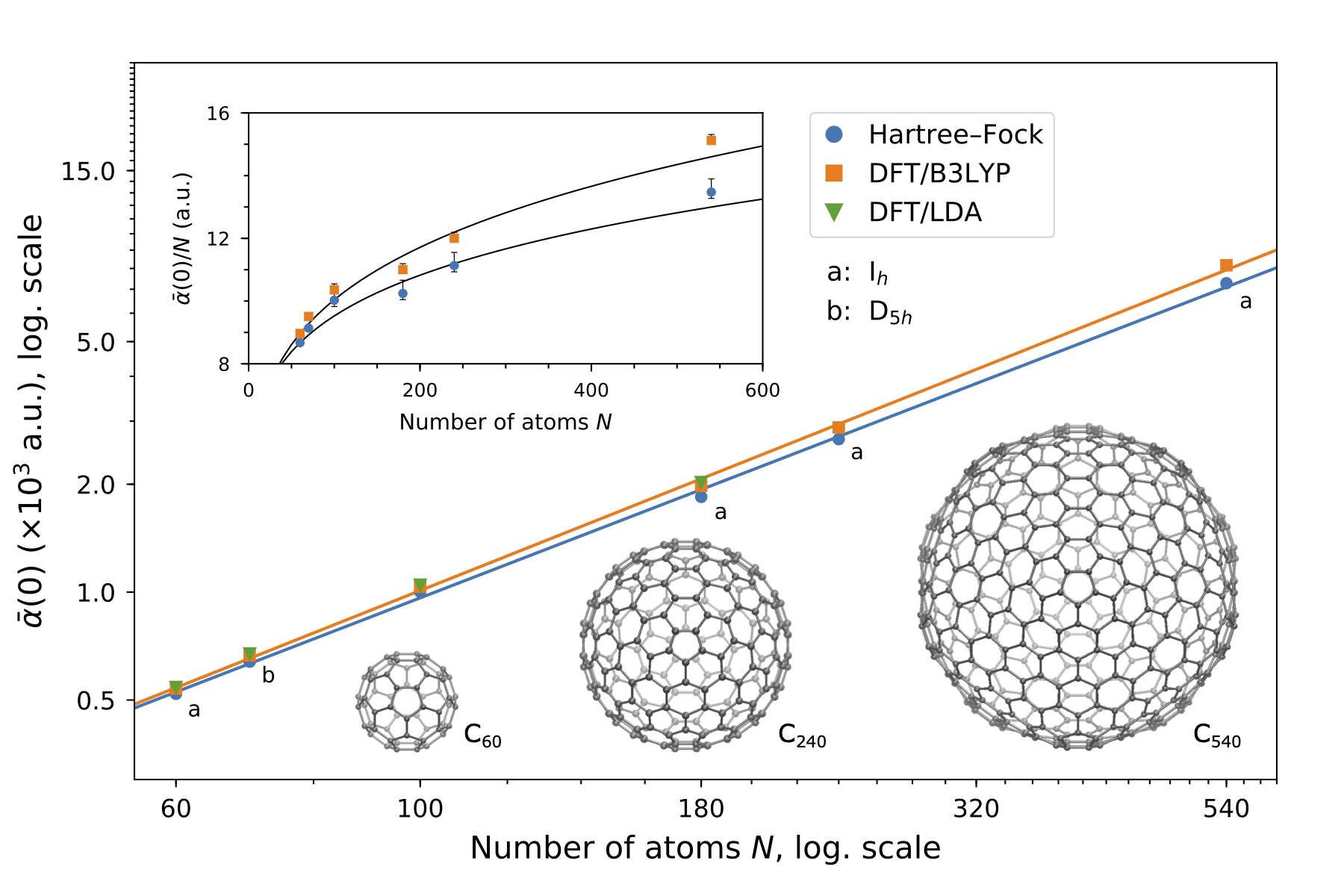
With a highly efficient MPI/OpenMP implementation of linear response functions (here specifically complex polarization propagator theory), calculations have been performed of the frequency-dependent polarizabilities for fullerenes consisting of up to 540 carbon atoms. These calculations were performed on AMD EPYC Zen2 64-core CPUs. See Brand et al. (2021) for further details.
HPC-GPU
GPU-accelerated Fock matrix construction
VeloxChem diagonalizes the Fock matrix in SCF iterations. Up to a point of some 30,000+ basis functions, this diagonalization step does not represent a bottleneck in the calculation and the Fock matrix construction shows sub-quadratic scaling with respect to system size. See Li et al. (2025) for further details.
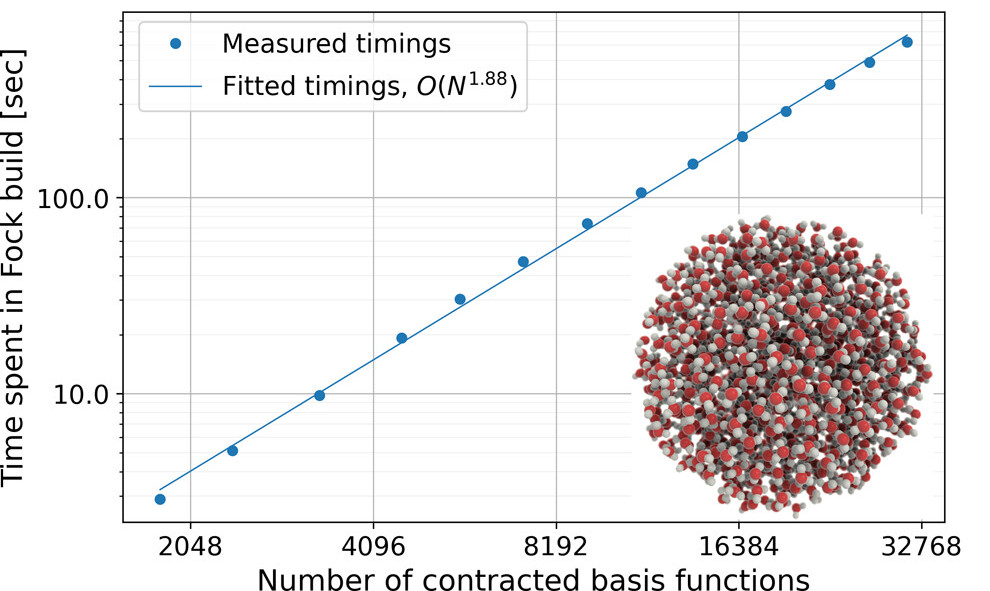
Timings are obtained with use a single AMD MI-250X node with 4 GPUs.
Multi-node acceleration
VeloxChem implements MPI for multi-node acceleration. It is recommended to run 1 MPI-rank per node and as many OpenMP threads as there are GPU devices on the node.
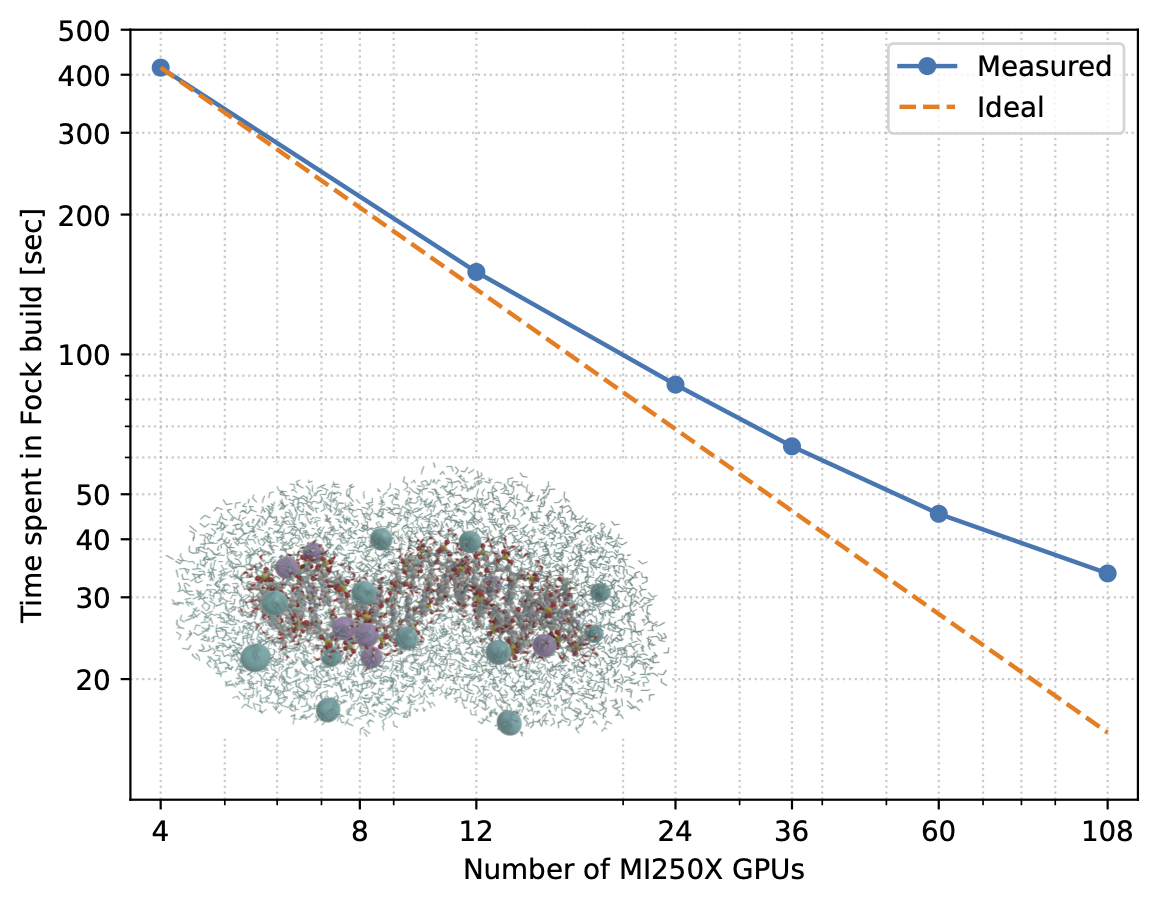
Strong scaling report using a range of 1–27 nodes of type AMD MI-250X with 4 GPUs. The system is a complete DNA sequence with 20 base pairs and includes a solvation shell of waters in the QM region to properly solvate the phosphate backbone, and timings refer to the construction of an auxiliary Fock matrix in a linear response calculation.
- Brand, M., Ahmadzadeh, K., Li, X., Rinkevicius, Z., Saidi, W. A., & Norman, P. (2021). Size-dependent polarizabilities and van der Waals dispersion coefficients of fullerenes from large-scale complex polarization propagator calculations. J. Chem. Phys., 154(7), 074304. 10.1063/5.0040009
- Li, X., Linares, M., & Norman, P. (2025). VeloxChem: GPU-Accelerated Fock Matrix Construction Enabling Complex Polarization Propagator Simulations of Circular Dichroism Spectra of G-Quadruplexes. J. Phys. Chem. A, 129(2), 633–642. 10.1021/acs.jpca.4c07510